Data maturity: what level is your company at?
Learn the 5 levels of data maturity, find out where your company stands with three practical questions, and see what it takes to move up a level.
In short
- Data maturity is a company's ability to collect, organize, access and use data to make decisions with confidence, regardless of the software it pays for.
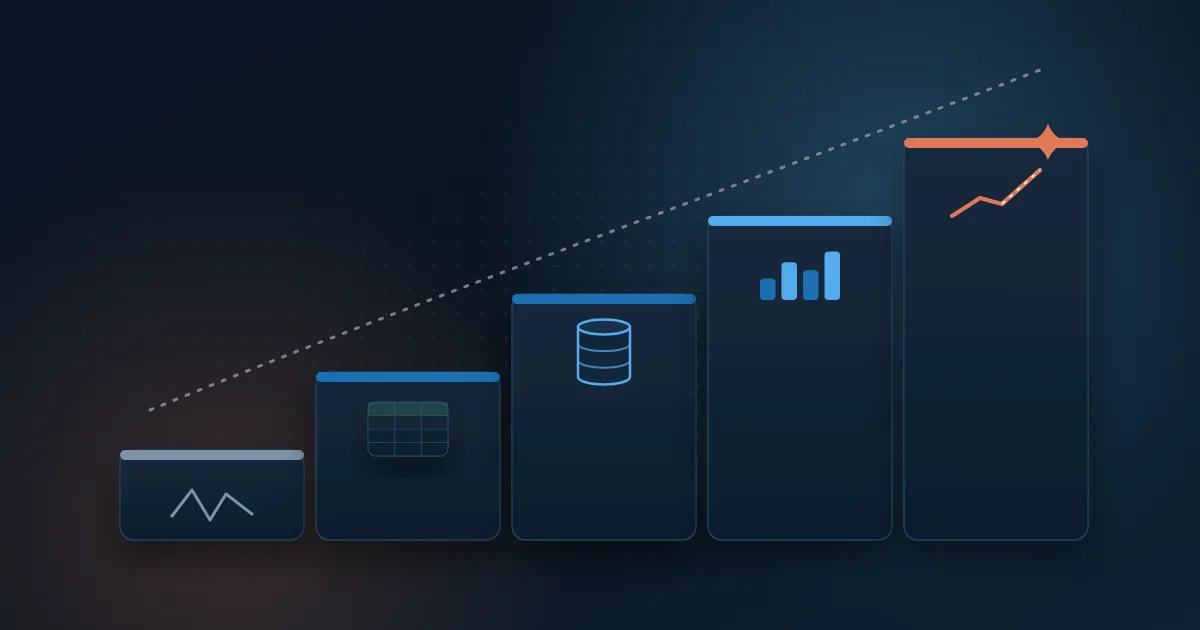
- The five levels of data maturity are chaotic, reactive, structured, integrated and predictive, and having Power BI or Tableau does not, on its own, get you past level 3.
- A quick assessment looks at three signals: time to close the monthly report, whether the same metric differs across systems, and access to yesterday's data without manual compiling.
- To move up a level, order matters: first define metrics and data owners, then integrate sources, automate updates, and only then apply AI and predictive analytics.
Only 12% of Brazilian companies have high data maturity.
88% are operating with incomplete, disorganized or outdated data.
And most don't even know what level they're at.
What is data maturity and why does it matter now?
Data maturity isn't about having the most expensive software. It's the degree to which your company can collect, organize, access and use data to make decisions reliably and consistently.
Companies with low maturity make decisions with yesterday's data, from side spreadsheets or manual reports that nobody knows are correct.
Companies with high maturity make decisions in real time, with integrated, traceable and reliable data.
The difference isn't just operational. It's competitive.
The 5 levels: where is your company?
Level 1: Chaotic
Data scattered across spreadsheets, emails and systems that don't talk to each other. Reports take days to be ready. Decisions are based on gut feeling or on whoever shouted loudest. No data has a clear owner.
Most common symptom: the team spends more time compiling than analyzing.
Level 2: Reactive
The company understands it has a data problem, but only acts when something goes wrong. There is some structure, but it is inconsistent. Each department has its own way of organizing information.
Most common symptom: the same metric has different values depending on who pulls the report.
Level 3: Structured
Data processes start to be formalized. There is a central system, but integration is still partial. There is visibility, but not in real time. Decisions start to be based on data, but there is still a reliance on manual processes.
Most common symptom: the dashboard exists, but nobody trusts it 100%.
Level 4: Integrated
Data flows between systems. The team makes decisions with up-to-date information. There is governance: owners for each data set, documented processes and end-to-end visibility.
Most common symptom: almost there, but there are still blind spots in some areas or products.
Level 5: Predictive
The company doesn't just track what happened. It anticipates what will happen. Machine learning models and advanced analytics feed strategic decisions. Data is treated as a strategic asset.
Most common symptom: fewer than 12% of Brazilian companies are at this level.
Why do most companies overestimate their level?
Having a dashboard doesn't mean high maturity. Having Power BI or Tableau doesn't mean organized data. A BI system without integration between sources is an expensive tool running on bad data.
The right question isn't 'which tool do you use'. It's 'can you make an important decision right now, with reliable data, without waiting for a manual report?'
If the answer is no, you're at level 1, 2 or 3, regardless of the software your company subscribes to.
What keeps companies from moving forward?
Three barriers come up again and again, regardless of industry:
• Disconnected systems that produce different versions of the same information
• No clear owner for each data set: without an owner, nobody ensures quality
• A side-spreadsheet culture: the system exists, but the team doesn't trust it and builds its own tracking
These barriers aren't solved by buying a new tool. They're solved by reorganizing the foundation, connecting what is disconnected and defining who is responsible for what.
How do you know where you are today?
Three practical questions for a quick assessment:
• How long does your team take to close the monthly report? (More than 2 days points to level 1 or 2)
• If two managers pull the same data from different systems, do they get the same result? (If not, it's level 2 or 3)
• Can you know today what happened in the operation yesterday, without asking someone to compile it? (If not, it's level 1, 2 or 3)
What does standing still cost?
Every level below where you could be has a cost: hours of manual work, decisions made with wrong data, opportunities lost for lack of visibility.
With Brazil's tax reform (Reforma Tributária) requiring traceability, AI agents requiring an organized foundation and the market operating more and more in real time, the cost of low data maturity is growing.
It's no longer about being efficient. It's about being able to operate.
How to move up a level in practice
There is no jump from level 1 straight to level 5. Each level depends on the foundation built in the previous one, and skipping steps usually produces good-looking dashboards on top of data nobody trusts.
The safest path is to treat each transition as a project with a clear goal and a short delivery cycle:
- From level 1 to 2: map your data sources, choose the metrics that really matter and name an owner for each one.
- From level 2 to 3: write a single definition for each metric and centralize data in one base that every department uses.
- From level 3 to 4: integrate systems such as ERP and CRM and automate updates, ending manual compiling.
- From level 4 to 5: use the now-reliable history for forecasts, alerts and AI models tied to concrete decisions.
Start with the area where bad data costs the most, such as finance or operations. A visible result in one area wins over the others faster than a large corporate plan.
How to measure whether your company is improving
Data maturity is not measured just once. After the initial assessment, track a few indicators, reviewed every quarter, to see whether the effort has a real effect:
- Time between a new question from leadership and an answer backed by reliable data.
- Number of side spreadsheets kept outside the official system.
- Share of metrics with a documented definition and a named owner.
- How often data is updated: monthly, weekly, daily or near real time.
- Number of meetings where the debate is about which number is right, not about what to do.
If these numbers improve, the company is moving up, even without buying any new tool. If they don't change, the project is delivering technology, not maturity.
Do you know what level your company is at?
Wolkee runs the assessment, identifies the bottlenecks and lays out a practical path to the next level, with no rigid scope.
Tell us about your situation. Wolkee knows how to unlock it.
Frequently asked questions
What are the levels of data maturity?
The model used in this article has five levels: chaotic, reactive, structured, integrated and predictive. They range from data scattered across spreadsheets with no owner to integrated, governed data that feeds forecasts and AI models. Other models use different names, but the progression logic is similar.
How do you assess a company's data maturity?
Assess four areas: data quality, integration between systems, governance, and how data is actually used in decisions. In practice, the assessment combines conversations with managers, a map of data sources and a simple test: how long it takes to answer a business question with reliable data. Wolkee offers a free 30-minute assessment.
What is the difference between data maturity and data governance?
Data governance is one of the pieces of maturity. It defines rules, owners, quality standards and who can access each piece of data. Data maturity is the broader outcome: it includes governance, but also system integration, technology, team skills and a culture of deciding with data. Without governance, a company rarely gets past level 3.
Can you use AI without high data maturity?
You can experiment, but the results depend on the foundation. AI models and agents work with the data available: if it is incomplete, duplicated or outdated, the AI repeats the same errors faster. In general, it makes sense to have at least integrated data and well-defined metrics before bringing AI into critical decisions.