Call centers in 2026: AI cut manual work, but created a bottleneck no one expected
AI in call centers cuts manual work, but it fails with fragmented data. See which data to prepare, how to get started and how to measure results.
In short
- AI in call centers reduces manual work in triage, categorization and response drafting, but it only gets things right with integrated, standardized customer data.
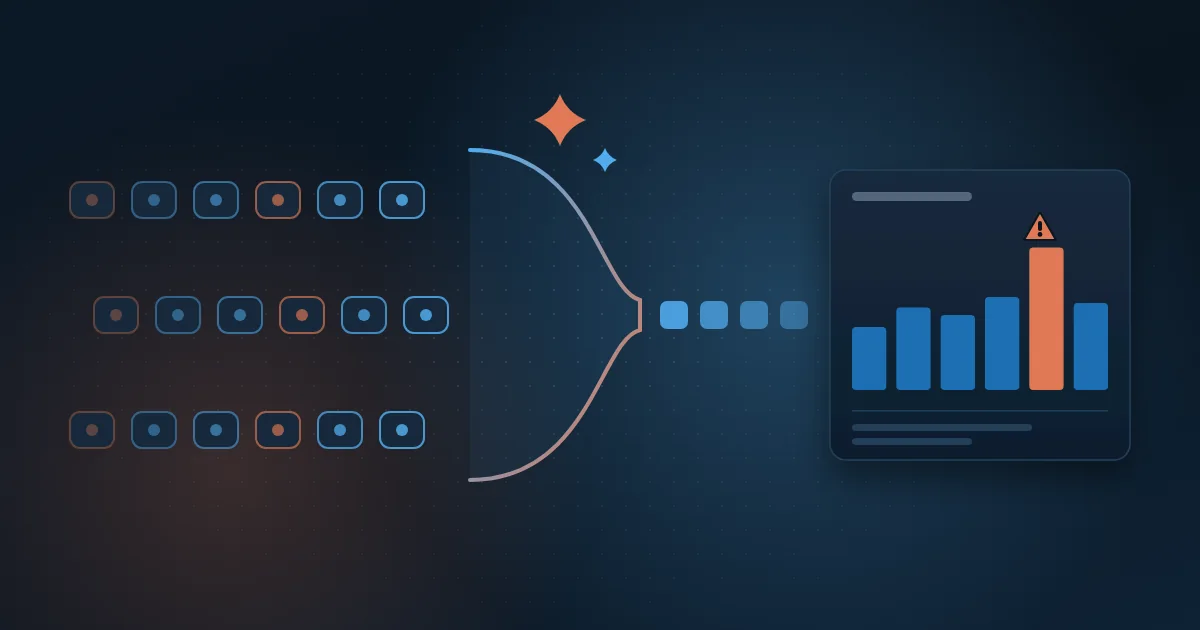
- When customer history is fragmented across several systems, AI gets recommendations and routing wrong, and the time saved comes back as manual correction.
- With AI, human work in the call center does not disappear: it shifts to context validation, exception handling and data governance.
- Before automating, a call center should map its data sources, standardize contact reasons and measure data quality in a pilot process.
How automation exposed the problem hiding behind day-to-day operations
Generative AI promised to eliminate manual work in call centers. Ticket triage, call categorization, drafting responses: all automated. And it worked.
But those who thought implementing AI was the end of the story are now discovering it was only the beginning of a different problem.
What automation revealed
When you remove the need for manual data management, you don't eliminate the demand for well-structured data. You change who needs to deliver it and how.
AI doesn't work with bad data. It works faster with it. And it amplifies errors at scale.
A typical call center that implemented chatbots and AI agents found something uncomfortable soon after: interaction quality dropped. AI agents started making wrong recommendations because customer history was fragmented across multiple systems. Tickets were misrouted because intent data had never been standardized. The time saved through automation was consumed by exceptions, reprocessing and manual effort to fix what the AI got wrong.
The time saved through automation came back as corrections.
The real bottleneck of 2026
The problem is no longer having people typing. It's having data that AI can understand.
Operations that implemented AI without first solving data quality problems face operating costs up to 40% higher than planned. Because every error amplified by AI requires human intervention. Every exception has to be resolved manually. Every comprehension failure takes more time than a simple human response would have.
Many call centers found that 60% of an AI agent's time is spent trying to interpret or find context in legacy data. That's not a technology problem. It's a data structure problem.
What data AI needs to work in a call center
Before choosing a tool, look at the data AI will consume. In a call center, some data has a direct impact on the quality of answers and routing.
- A unique customer ID, the same in the CRM, the phone system, WhatsApp and email.
- Consolidated contact history, with the date, channel, reason and outcome of each interaction.
- Standardized contact reasons, with a few clear categories and usage rules the team knows.
- Consistent call dispositions, using pick lists instead of free text whenever possible.
- An up-to-date knowledge base, with an owner and a review date for each procedure.
- A record of the outcome: resolved on first contact, transferred, repeat call or complaint.
When any of these items is scattered across systems that do not talk to each other, AI fills the gap on its own. That is where wrong recommendations and misrouted tickets come from.
Fixing this does not always require replacing systems. Often, the path is to integrate what already exists and set clear rules for data entry and dispositions.
What changes in practice
Manual work doesn't disappear. It changes shape.
The analyst who used to categorize tickets manually now needs to make sure the data used by AI is clean, consistent and traceable. The operation that used to depend on people to respond now depends on people to structure the context the AI will use.
It's not about eliminating humans. It's about redirecting humans to what AI can't do on its own: context validation, decisions on exceptions and data governance.
How to start: a data assessment before automating
The safest path reverses the usual order. First, understand the data. Then, decide where AI comes in.
- Map the sources that feed customer service: phone system, CRM, WhatsApp, email, ERP and spreadsheets.
- Pick a high-volume process with clear rules, such as ticket triage or order status inquiries.
- Measure the data quality of that process: duplicates, empty fields and inconsistent categories.
- Fix the root cause, not just the data: data entry rules, dispositions and integration between systems.
- Deploy AI in that process and compare the metrics with the previous period.
- Expand to the next process only when the first one is stable.
This cycle avoids automating the error and creates a concrete baseline for deciding next steps. It also shows quickly whether the bottleneck is in integration, data entry or the way the team logs interactions.
How to measure whether AI is helping or creating rework
The cost of correction is usually silent. Automation shows gains in volume handled, while rework shows up scattered across other queues and teams.
That is why measurement has to cover the whole service flow, not just the automated step. These metrics help show the full picture:
- First contact resolution (FCR) for interactions handled by AI.
- Repeat calls about the same reason within a few days.
- Handoff rate from AI to a human agent.
- Tickets reclassified or rerouted after automated triage.
- Average handle time (AHT) for cases that reach a human after AI.
- Customer satisfaction (CSAT) by channel and by contact reason.
Ideally, track these numbers in a single dashboard that combines data from the phone system, the CRM and the AI platform. If reclassifications or repeat calls go up, investigate the data before switching tools.
The right question for call center leaders now
It's not "are we going to replace humans with AI?",
It's: what are our biggest data bottlenecks to making AI work well?
Because in 2026, that's the real competitive advantage. Not who has the most sophisticated AI. Who has the most organized data foundation to feed it.
Which of your processes is being affected by disorganized data when you try to automate?
Wolkee assesses this structure before any implementation. No rigid scope, no vague promises.
Frequently asked questions
How is AI used in call centers?
AI is mainly used for triaging and categorizing calls and tickets, intent-based routing, chatbots and virtual agents for first-line service, call transcription and summaries, and suggested replies for agents. It also supports quality analysis, because it can review every interaction instead of just a sample.
Will AI replace call center agents?
Not completely. AI takes over repetitive, high-volume tasks, but complex cases, exceptions and unhappy customers still require people. What changes is the team's role: less typing and manual categorization, more context validation, exception handling and care for the quality of the data that feeds AI.
Why does AI make mistakes in customer service?
Often, the error comes from the data, not the model. Customer history scattered across different systems, unstandardized contact reasons and an outdated knowledge base lead to wrong answers and incorrect routing. AI works with the context it receives. If that context is incomplete or inconsistent, the error repeats at scale.
What is the difference between a chatbot and an AI agent in a call center?
A traditional chatbot follows predefined flows and answers, like a decision tree. An AI agent uses language models to interpret the question, query systems and knowledge bases, and take actions, such as opening a ticket or checking an order. Because it has more autonomy, an AI agent depends even more on integrated, reliable data.